An Open Letter to Eye, Organ, and Tissue Donor Families
Ted, a cornea transplant recipient in 2024 wrote an open letter to all donor families, recognizing those who may not hear from those who benefit from the gift of sight or life.
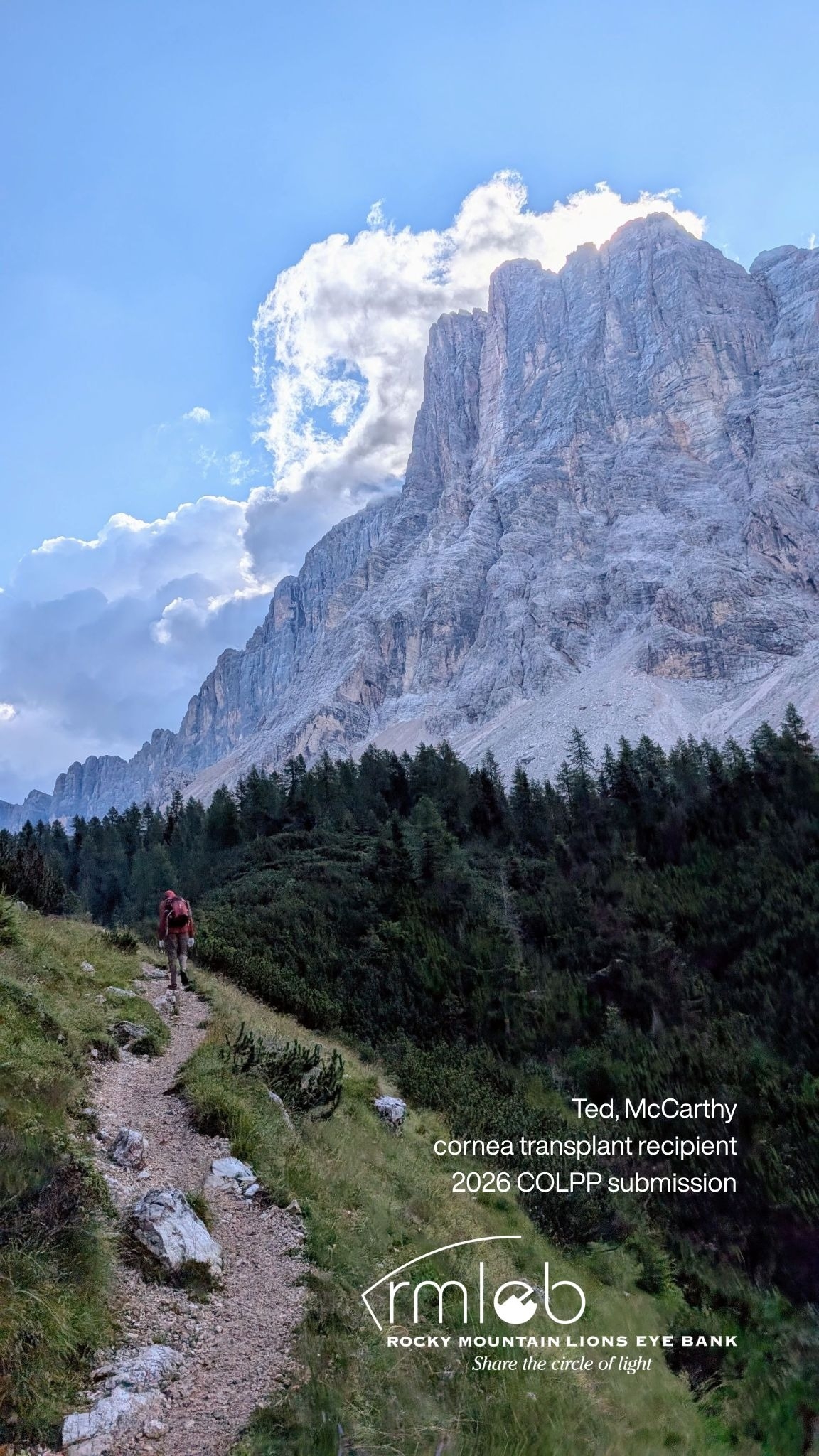
Rocky Mountain Lions Eye Bank (RMLEB) facilitates letter writing between eye tissue donor families and recipients. Writing to a donor’s family is a personal choice, and while some recipients decide not to, their gratitude is no less sincere. RMLEB received this letter from a cornea recipient as an open thank you to all donor families to express the profound gratitude recipients feel for their renewed gift of sight.
An Open Letter to Donor Families
To All Eye, Organ, and Tissue Donor Families,
I received a cornea transplant, and have regained sight in my right eye, because of the Rocky Mountain Lions Eye Bank, and the generous donation of a young man named David. I know nothing about David, nor his family, and cannot imagine the grief and pain that have accompanied them in the time since his passing — the very time, incidentally, that I have resumed my life with improved sight.
I write here in an attempt to express my tremendous thanks to RMLEB, David, and his family — and to all eye, organ, and tissue donors and their families, wherever they are. Because I use that phrase, “resumed my life,” very intentionally. I turned 40 last spring and moved to Berlin shortly after; I’d wished to move to the city for years but repeatedly delayed the decision because of my vision. I was diagnosed with keratoconus, a condition that weakens the cornea and ultimately necessitated the transplant, over a decade ago. For years the diagnosis affected my life very little — until one evening the cornea experienced a “hydrops” and ruptured, and I nearly instantaneously lost all vision in my right eye. It healed slowly and painfully, over the course of six months; but a few years later it happened again. And then it healed and happened again.
With the arrival of each hydrops came the crushing realization that my next half-year of life would be filled with partial blindness, periodic pain, medications, doctor’s visits, diminished self-esteem, and heaps of uncertainty. All until the eye could eventually heal — at which point I learned to await, and fear, the next rupture. It is difficult to plan for a future when faced with such uncertainty, and with the knowledge that another long stretch of blindness will one day strike without warning. I felt as though my life was on hold.
I was blind in the eye for more than a year before the transplant surgery, but within a month I could see better than at any point in the prior eight years. I’m a very active person: I regularly travel to far-flung places, and enjoy trail running, skiing, biking and many other activities where two eyes are helpful, if not necessary. Living blind in one eye made all these things unsurprisingly harder, frequently scary, and sometimes impossible. Even when the cornea behaved as it should, in the periods between blindness, a small part of me lived in fear: would I be in some remote place, hours (or days) from reliable healthcare, when my eye failed again?
I drove cross-country the day before my surgery, and couldn’t get my mind off the person, unknown to me then, whose cornea I was to receive I realized they were likely living their last minutes on earth or already had. The thought filled me with immense gratitude, though I didn’t yet know toward whom — I felt what I can only describe as a sort of connection to everyone in this world, and a realization of the intricate, often invisible ways in which we rely on, and are supported by, each other.
Every day now I remember that I’ve been supported by David and his family — and though we’ll unlikely ever meet, I intend to forever feel gratitude to them for this gift. I am certain my life has been incredibly different from that of David’s family since the day of his passing, and that theirs has been, in so many ways, unfathomably harder. But I hope the knowledge that their loss has improved my life in such a dramatic way might, if only a little, soften this pain.
Ted
Eye tissue donor family members and eye tissue transplant recipients can learn more about how to write their own correspondence letters by visiting Corneas.org, and going to Donor Families or Recipients.